Hello everyone, I’m Tao.
This is my WhatsApp: +86 131 6957 7167
This is my ECU tool store: https://autoecumaster.com/
Feel free to message me on WhatsApp if you find any items you like and want special offers.
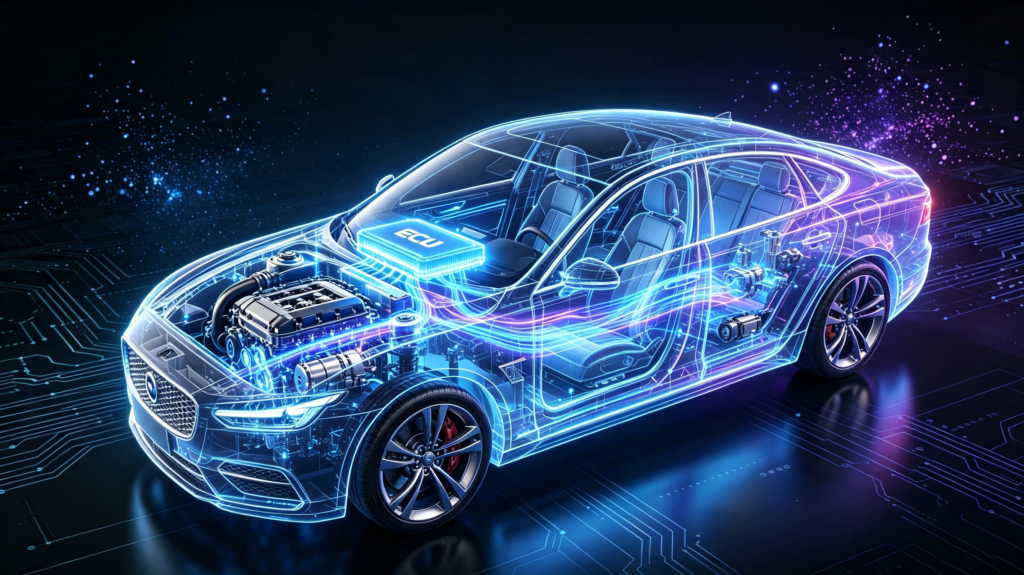
Every modern vehicle is equipped with 50 to over 100 ECUs. Have you ever wondered what makes these ECUs run from the inside? In this session, we will talk about the commonly used MCU models in automotive ECUs.
Automotive-Grade MCUs: A World Apart
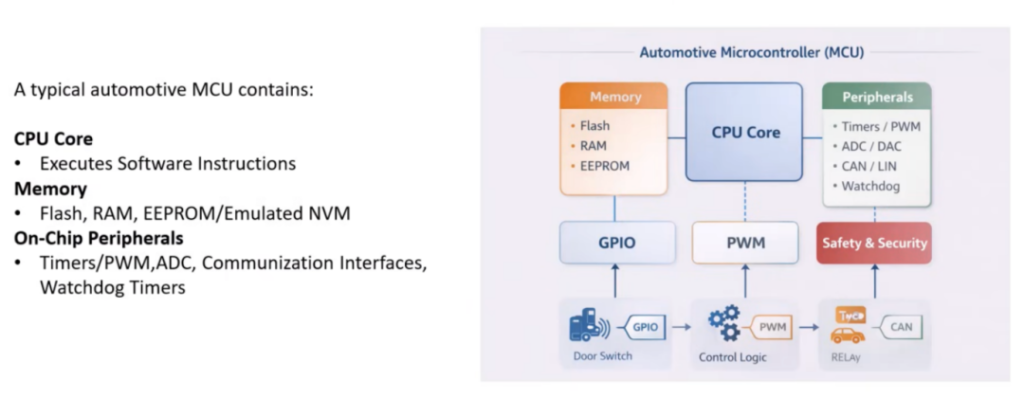
A Microcontroller Unit (MCU) is a single-chip embedded computer integrating a central processing unit, memory and peripherals on one chip for real-time control. What are the core components of an MCU?
At its heart is the CPU core, with common variants including Cortex-M, Infineon TriCore, Renesas RH850, and more. It is equipped with memory: Flash memory, RAM and ROM. It integrates timers, PWM modules and analog-to-digital converters. Communication interfaces support CAN, LIN and Ethernet. It also features built-in watchdog timers, security and encryption modules.
Example for automotive application scenarios: When you press the door switch, the microcontroller reads GPIO signals, executes logical operations, and transmits CAN bus messages to the power control module.
Can ordinary consumer-grade microcontrollers be used in automobiles? The answer is no. This is because automobiles impose exclusive stringent requirements:
- Real-time deterministic operation performance
- Operating temperature range covering -40℃ ~ +125℃
- Product life cycle requirement of more than 15 years
- Compliance with the ISO 26262 functional safety standard
- Support for cybersecurity protection
Automotive-grade microcontrollers must be equipped with lockstep cores, ECC error correction for Flash and RAM, watchdog timers and self-test units, as well as Hardware Security Modules (HSM). This explains why regular consumer-grade MCUs cannot be adopted for automotive applications.
Common MCU Classification by Automotive Domains
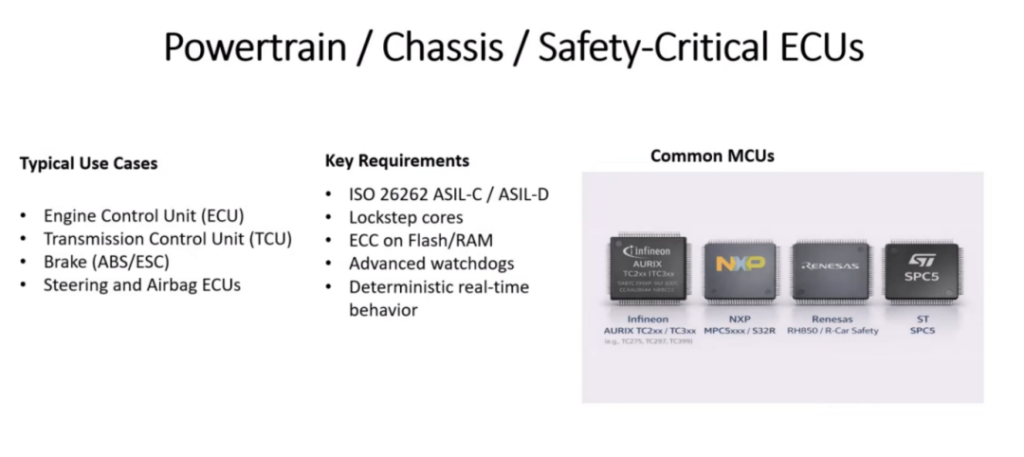
1.Application Scenarios for Powertrain and Safety-Critical ECUs
engine ECU, transmission ECU, airbag systems, ABS, steering systems and other safety-related controllers. Core requirements: lockstep cores, high-speed timers, dedicated safety peripherals. Common models: Infineon: TC2XX, TC3XX (TC387 is currently the most widely used) Renesas: RH850 NXP: MPC5X, S32R STMicroelectronics: SPC5
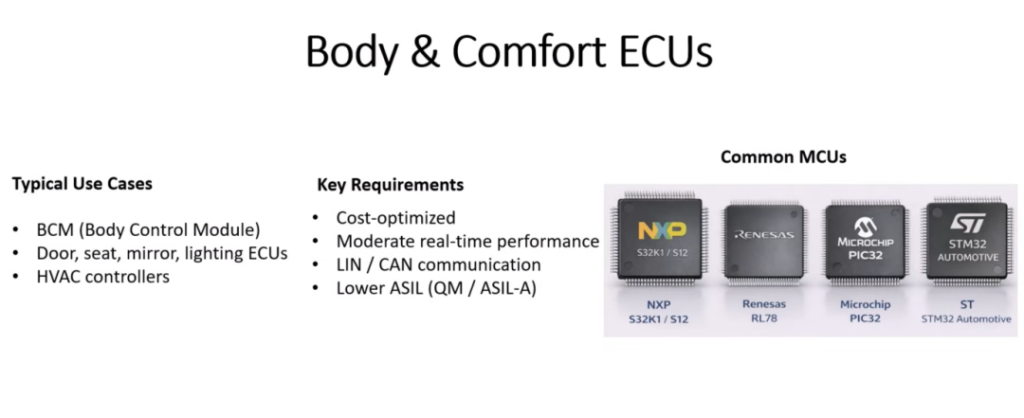
2.Body & Comfort ECUs
Application Scenarios: Body control modules, door modules, seat controllers, lighting modules and HVAC controllers.
Common Models:
NXP: S32K, S12
Renesas: RL78
Microchip: PIC32
STMicroelectronics: Automotive-grade STM32
Core Requirements: Optimized hardware cost, moderate real-time performance, CAN/LIN communication support, compliant with lower ASIL/QM safety levels.
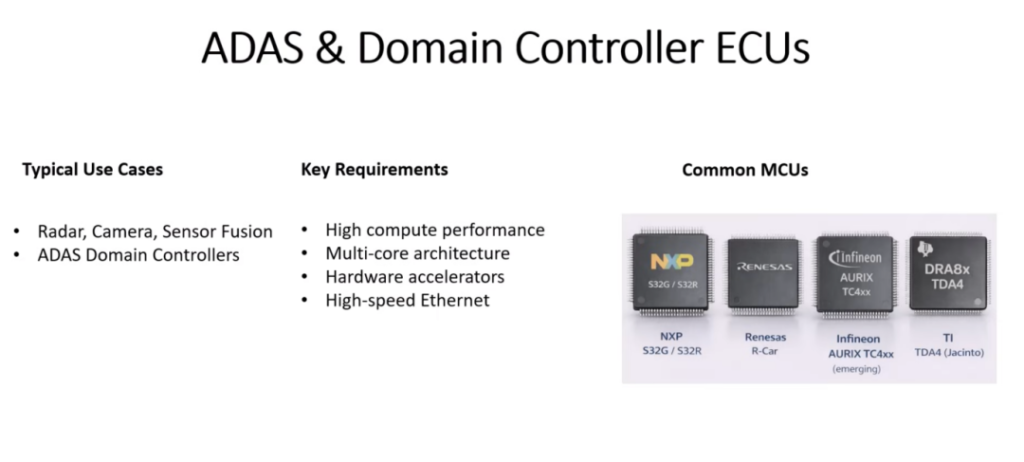
3.Advanced Driver Assistance Systems (ADAS) & Domain Controllers
Application Scenarios: Radar, cameras, sensor fusion, and vehicle domain controllers.
Common SoCs / Microcontrollers:
NXP: S32G, S32R
Renesas: R-Car
Infineon: TC4X
TI: TDA4
Core Requirements: Multi-core architecture, hardware accelerators, support for Ethernet and PCI interfaces, compatible with P1 EDA architecture.
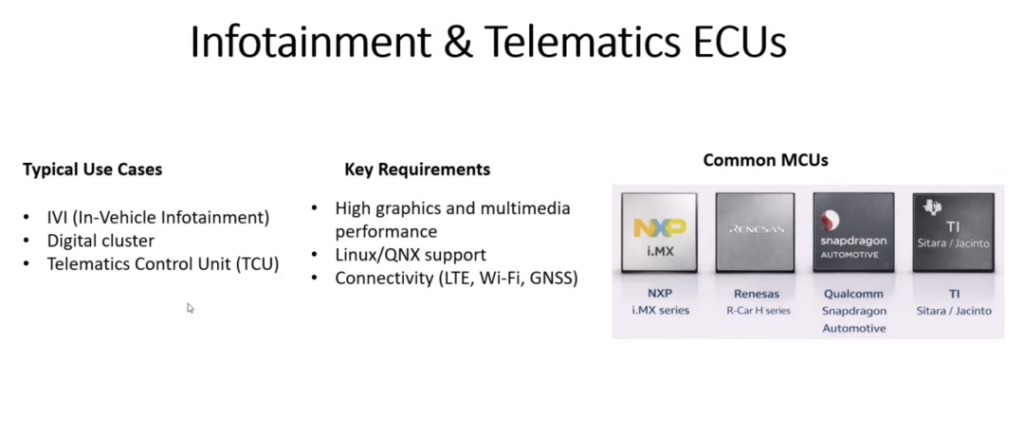
4.In-Vehicle Infotainment & Telematics ECUs
Application Scenarios: In-vehicle audio & infotainment, liquid crystal instrument clusters, telematics control units.
Common SoC Chips:
NXP: i.MX series
Renesas: RH series
Qualcomm: Automotive-grade Snapdragon chips
TI: Sitara series
Supported Operating Systems: Linux, Android, QNX
Core Requirements: Powerful graphics and multimedia performance, abundant connectivity interfaces.
MCU Core Architecture & AUTOSAR Compatibility
In terms of microcontroller core architectures, they are mainly divided into two major categories.
One is the ARM architecture. Among its variants, the Cortex-M cores are primarily deployed in automotive body systems and body control modules. Cortex-R cores focus on real-time processing performance and are widely used in safety-critical control scenarios. Cortex-A cores are generally integrated into in-vehicle infotainment systems and ADAS domain controllers.
The other category consists of proprietary architectures dedicated to automotive applications, represented by Infineon TriCore and Renesas RH850. These architectures offer excellent compatibility with the hardware abstraction features of the AUTOSAR standard.
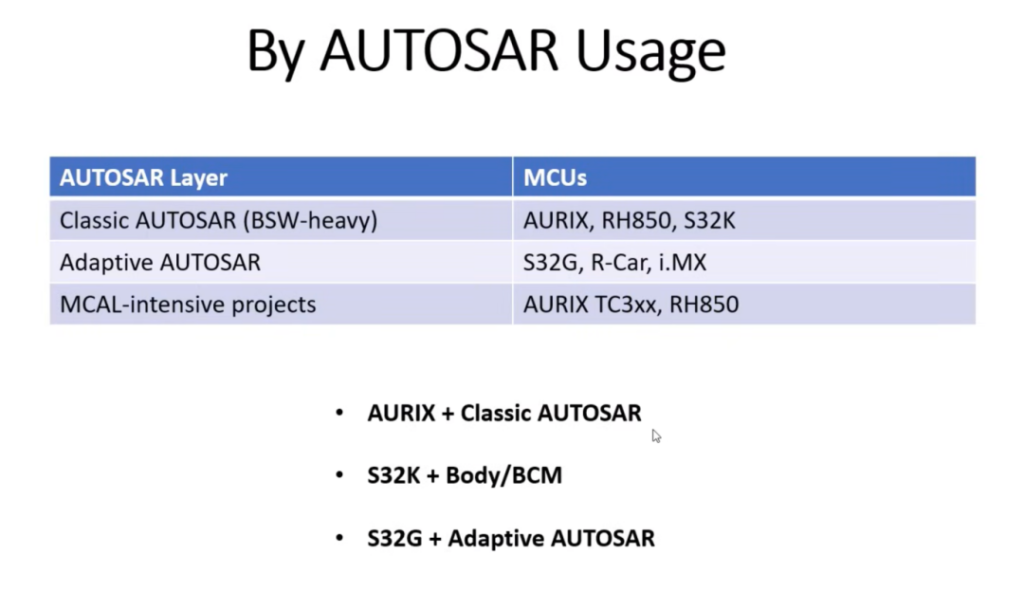
There are clear distinctions when selecting MCUs for AUTOSAR implementation.
The Classic AUTOSAR platform commonly adopts Infineon AURIX, Renesas RH850 and NXP S32K series.
The Adaptive AUTOSAR platform mostly utilizes NXP S32G, Renesas R-Car and NXP i.MX series.
The MAL architecture relies on hardware abstraction and vendor-independent layered software design, with Infineon AURIX, TC3X and Renesas RH850 microcontrollers as preferred options.
Notably, the Infineon AURIX series stands out for outstanding compatibility, supporting both Classic AUTOSAR and Adaptive AUTOSAR simultaneously.
Overall, the microcontroller serves as the core brain of automotive ECUs. Different functional domains of vehicles require matching dedicated MCU models. Application sectors including powertrain, body electronics, intelligent driving and in-vehicle infotainment each have tailored MCU selection schemes together with corresponding safety level standards.
Safety, real-time performance and reliability are the three core criteria for automotive MCU selection. Moreover, the adoption of the AUTOSAR architecture effectively enables software portability across different microcontroller models.
Hello everyone, I’m Tao.
This is my WhatsApp: +86 131 6957 7167
This is my ECU tool store: https://autoecumaster.com/
Feel free to message me on WhatsApp if you find any items you like and want special offers.