ECU Programming vs ECU Tuning: What Is the Difference?
ECU programming and ECU tuning are closely related automotive technologies, but they do not mean exactly the same thing. Both can involve electronic control unit software and data, yet their objectives, workflows and technical requirements can differ significantly.
For automotive technicians, ECU repair specialists and professional workshops, understanding the difference between ECU programming and ECU tuning helps determine which tools, software functions and procedures are appropriate for a particular job.
This guide explains how ECU programming and ECU tuning work, when each is used, what equipment may be required and how to select an appropriate workflow for different automotive applications.
What Is ECU Programming?
ECU programming involves reading, writing or otherwise managing supported data in an electronic control unit. Depending on the controller and programming protocol, this can include software, firmware, calibration data and other memory areas.
ECU programming is used in several professional automotive service applications, including:
- Reading original ECU data
- Writing supported software or data files
- ECU replacement and repair
- Supported ECU cloning procedures
- ECU recovery after certain programming failures
- Software updates when supported
- Transferring compatible data between control units
The exact functions available depend on the ECU hardware, software version, processor and programming method.
For example, replacing a damaged engine control unit may require a supported programming procedure to prepare a compatible replacement controller. This is a different objective from modifying engine calibration for a change in performance.
What Is ECU Tuning?
ECU tuning focuses on adjusting supported engine or powertrain calibration data to achieve a particular operating objective.
Depending on the vehicle and engine management system, calibration parameters may influence:
- Fuel delivery
- Ignition timing
- Boost pressure control
- Torque management
- Throttle response
- Engine operating limits
- Other supported engine control strategies
ECU tuning normally requires an understanding of the engine, the original calibration, the available adjustment parameters and the mechanical limits of the vehicle.
Not every ECU exposes the same calibration parameters, and not every modification is appropriate for every vehicle. Changes should be based on verified technical information and validated against the intended operating conditions.
ECU Programming vs ECU Tuning: Key Differences
| Feature | ECU Programming | ECU Tuning |
|---|---|---|
| Main objective | Read, write, update, restore or transfer supported ECU data | Adjust supported calibration parameters for a defined objective |
| Typical applications | Repair, replacement, software updates and supported cloning | Performance calibration, drivability and operating optimization |
| Original data backup | Important before supported write operations | Important before calibration changes |
| Required knowledge | ECU identification, protocols, memory and programming procedures | Calibration strategies, engine behavior and validation |
| Equipment | Compatible ECU programming tool and supported software | Suitable read/write equipment and calibration analysis tools |
| Verification | Programming result, ECU identification and diagnostics | Calibration integrity, diagnostics and appropriate operating tests |
The key distinction is the purpose of the operation. ECU programming describes the process of accessing and transferring supported data, while ECU tuning focuses on changing calibration settings for a specific operating objective.
Is ECU Flashing the Same as ECU Tuning?
No. ECU flashing and ECU tuning are related, but they are not interchangeable terms.
ECU flashing generally refers to writing supported software or data into a controller's non-volatile memory. ECU tuning involves preparing or adjusting calibration data.
A tuning workflow may use ECU flashing to transfer a modified calibration into the ECU. However, a flashing operation can also be used to install supported original software or perform a repair without changing the intended engine calibration.
For example, a technician may write a compatible original software file to a replacement ECU as part of a repair procedure. This is ECU programming, but it is not necessarily ECU tuning.
How ECU Programming Works
A professional ECU programming workflow begins by identifying the exact control unit and confirming that the intended operation is supported.
Step 1: Identify the ECU
Record the ECU manufacturer, part number, hardware number and available software identification. Vehicle model information alone may not be sufficient because the same vehicle can use different ECU versions.
Step 2: Confirm the Programming Method
Depending on the ECU, supported access methods may include OBD, Bench, Boot or other processor-specific interfaces.
The correct method depends on the exact ECU and programming protocol, not simply on whether the controller is installed in the vehicle.
Step 3: Read and Back Up Original Data
When the supported protocol allows it, read the original ECU data and save the resulting files before writing new data.
Record which memory areas were actually read. A single file should not automatically be treated as a complete ECU backup.
Step 4: Verify the Programming File
Before writing, confirm the target ECU, memory area, file size and compatibility. Checksum processing may also be required for certain supported operations.
Step 5: Write and Verify
Perform the supported Write operation with stable power and communication. Use the available verification function and complete the appropriate diagnostic checks afterward.
How ECU Tuning Works
ECU tuning requires a different emphasis because the objective is to change calibration rather than simply transfer data.
Step 1: Establish the Original Vehicle Condition
Before changing calibration, identify the engine and ECU configuration, review diagnostic trouble codes and establish whether the vehicle is operating correctly.
Existing mechanical or electrical faults should be investigated before attempting calibration changes.
Step 2: Obtain the Appropriate Original Data
Use a supported method to obtain the original ECU data. Keep the original physical read separate from any matching software file obtained through a Virtual Read service.
These sources are not necessarily identical, particularly if the ECU has previously been modified.
Step 3: Analyze the Calibration
Calibration work requires the correct software and knowledge of the target ECU's data structure. Technicians should identify relevant parameters and understand their relationship to engine operation before making changes.
Step 4: Prepare and Validate Changes
Any calibration changes should be appropriate for the engine hardware, fuel system, cooling capacity and other relevant vehicle characteristics.
Checksum requirements and file compatibility should be checked before programming.
Step 5: Program and Test
Write the prepared calibration using a supported programming procedure. Afterward, perform diagnostic checks and appropriate validation under controlled conditions.
A completed Write operation alone does not prove that a calibration is safe or suitable for the vehicle.
What Equipment Is Needed for ECU Programming?
The equipment required depends on the ECU, the intended operation and the available software support.
A professional setup may include:
- An ECU programming tool
- Compatible programming cables and adapters
- A suitable regulated power supply
- A computer running the required programming software
- Supported ECU connection diagrams
- Diagnostic equipment for post-programming checks
For advanced operations, additional adapters or dedicated connections may be required.
Before purchasing a programmer, check the exact ECU coverage and available functions rather than relying only on a list of vehicle brands.
What Equipment Is Needed for ECU Tuning?
ECU tuning may require the same basic read/write equipment used for ECU programming, together with additional calibration tools.
Depending on the vehicle and tuning workflow, these may include:
- ECU read/write equipment
- Calibration editing software
- Original and modified file comparison tools
- Diagnostic scanning equipment
- Suitable vehicle measurement and validation equipment
The programming tool provides access to supported ECU data, while calibration software is used to analyze and prepare changes. These are separate functions, even when a particular product integrates some of them.
OBD vs Bench vs Boot Programming
Programming access methods are an important consideration when choosing equipment for professional ECU work.
OBD Programming
OBD programming uses the vehicle's diagnostic connection for supported operations. It can be convenient when the required ECU function is available through the diagnostic interface.
Bench Programming
Bench programming connects directly to a supported ECU outside the vehicle. It can provide access to specific operations without relying on the vehicle's normal diagnostic connection.
Boot Programming
Boot programming is an advanced method for supported controllers that require a dedicated programming state or processor-level access. The exact procedure may require additional connections and careful preparation.
Not every ECU supports all three methods. Always confirm the correct access method for the exact controller before starting work.
For additional information, review the KT200II ECU Programming Modes page.
ECU Programming for Repair and Replacement
ECU programming is particularly important when a control unit needs to be replaced or restored.
A replacement ECU may require a supported software installation, data transfer, configuration procedure or other manufacturer-specific service operation.
Before proceeding, technicians should verify:
- Original ECU identification
- Replacement ECU compatibility
- Hardware and software differences
- Required memory areas
- Supported programming functions
- Required coding or adaptation procedures
Not every replacement ECU can be prepared by copying a single file. The correct procedure depends on the controller and vehicle system.
ECU Tuning for Performance and Drivability
ECU tuning may be used to change selected engine operating characteristics, provided the ECU and calibration support the intended adjustments.
Potential objectives can include improving throttle response, adjusting torque delivery or optimizing calibration for a particular hardware configuration.
Actual results depend on the engine, transmission, fuel quality, environmental conditions and the quality of the calibration.
Performance changes should not be guaranteed based solely on the use of a particular programmer. Appropriate testing is needed to evaluate the result.
Common Mistakes in ECU Programming and Tuning
Choosing a File Based Only on Vehicle Model
Vehicles with the same model name can use different ECU hardware or software. Confirm the exact ECU identification before selecting a file.
Skipping the Original Backup
Preserve the original data whenever the supported Read operation allows it. Keep the original file unchanged and use a separate working copy.
Confusing Programming With Calibration Editing
A tool that can write ECU data does not necessarily provide calibration editing functionality. Confirm which functions are included in the software.
Ignoring Checksum Requirements
Some programming operations require supported checksum processing. Verify the requirements for the exact ECU rather than assuming that every file is automatically corrected.
Ignoring Vehicle Faults
Programming or tuning should not be used as a substitute for diagnosing existing electrical or mechanical problems.
Failing to Verify the Result
After programming, use available verification functions and perform the appropriate diagnostic and functional checks.
How to Choose an ECU Programmer for Your Workshop
When selecting an ECU programmer, consider the type of work your workshop performs most frequently.
Important selection criteria include:
- Supported ECU and TCU families
- Available OBD, Bench and Boot functions
- Supported processors and memory operations
- Original data backup capabilities
- Software compatibility with your computer
- Availability of connection diagrams
- Software updates and technical support
- Compatibility with your existing repair workflow
If your primary business is ECU replacement and repair, prioritize the programming operations required for those jobs. If you also perform calibration work, verify whether the equipment supports your required file workflow and whether separate calibration software is necessary.
You can review the KT200II ECU Programmer product information and check the supported ECU list before deciding whether the tool fits your workshop requirements.
KT200II for Supported ECU Programming Applications
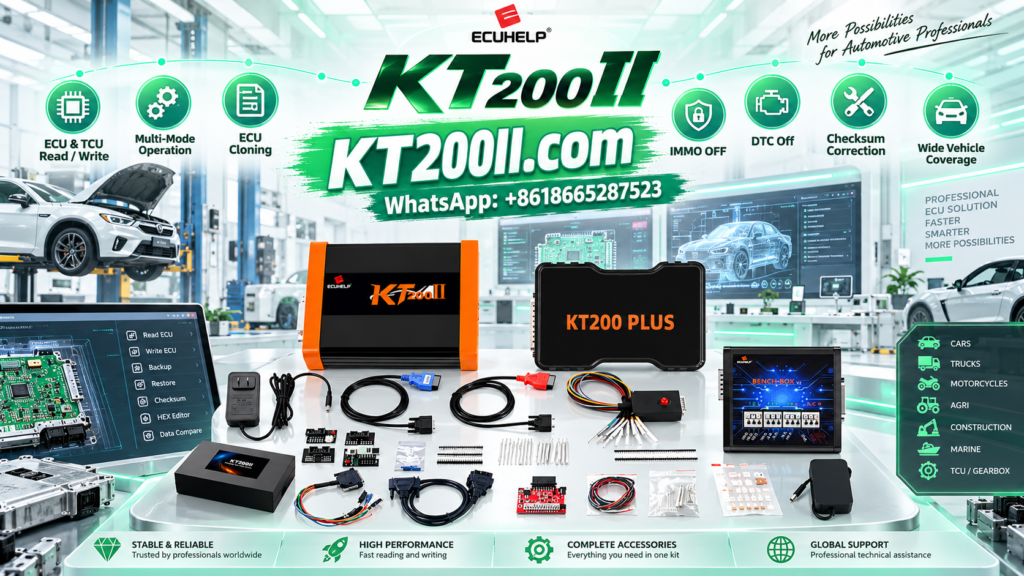
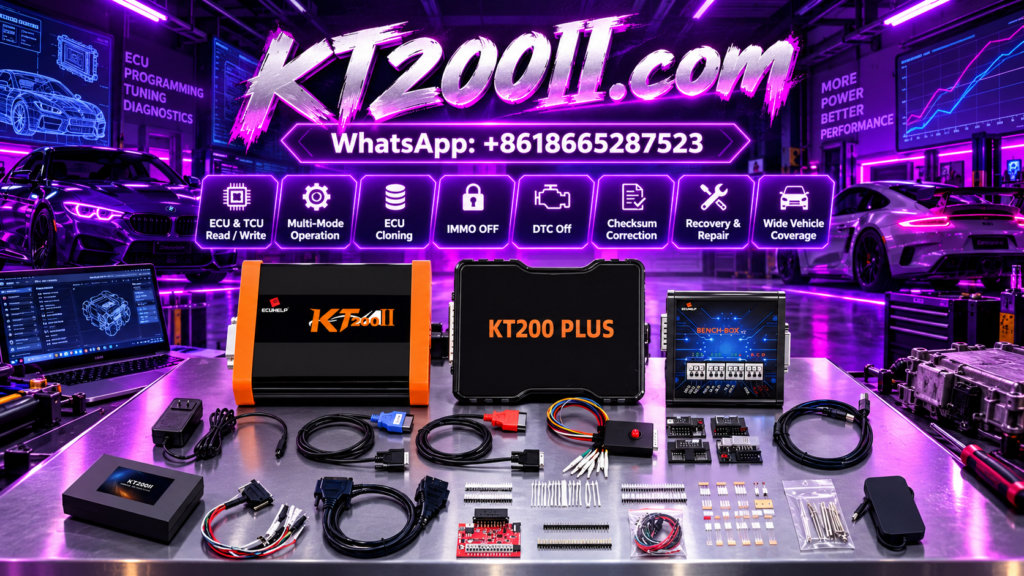
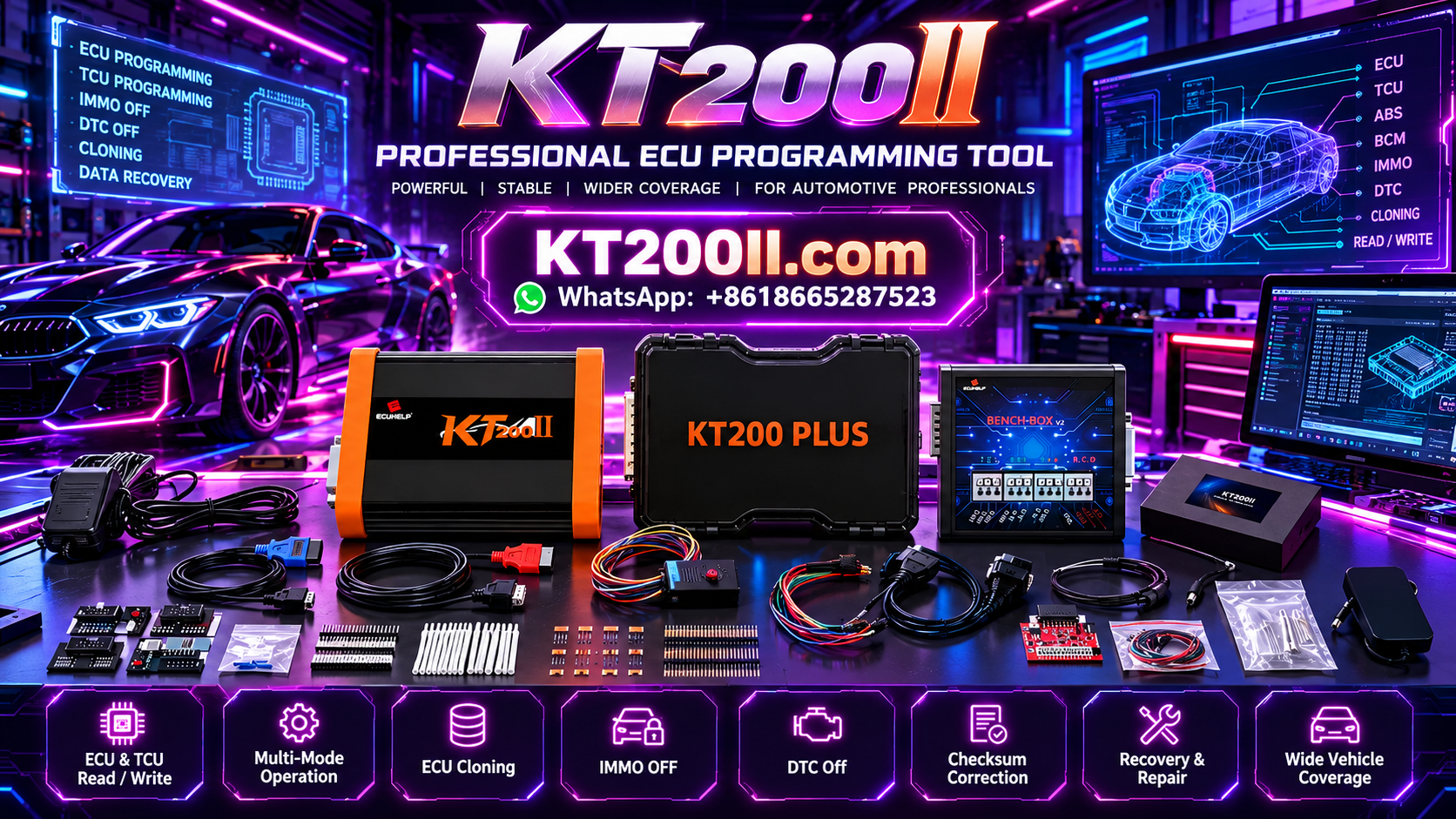
KT200II is an ECU and TCU programming solution for supported automotive control units. Depending on the exact ECU and available software functions, it can provide different programming methods for reading, writing and other supported operations.
For technicians who need to evaluate compatibility before beginning a job, the current support information should be checked against the ECU's actual hardware and software identification.
Visit the KT200II product page for product information, the software page for relevant software resources and the support list to review supported applications.
Frequently Asked Questions
Is ECU programming the same as ECU tuning?
No. ECU programming involves reading, writing or managing supported ECU data. ECU tuning focuses on adjusting calibration parameters for a particular operating objective. Tuning may use ECU programming to transfer the modified calibration.
Can an ECU programmer tune every vehicle?
No. Available operations depend on the ECU hardware, software, programming protocol and tool support. Calibration editing may also require separate software.
Does ECU flashing always change engine performance?
No. Flashing can install original software, update supported data or perform a repair. Performance changes depend on the contents of the file being programmed.
Can ECU programming be used for ECU replacement?
Yes, when the replacement procedure and target ECU are supported. The required steps may include software programming, data transfer, coding or adaptation.
Should the original ECU data be saved before tuning?
Yes. When a supported physical Read is available, preserving the original data provides a valuable reference before calibration changes are made.
Does a successful Write guarantee a successful tune?
No. A successful Write only indicates that the programming operation completed according to the tool's reporting. Calibration suitability and vehicle behavior require additional verification and testing.
Conclusion
ECU programming and ECU tuning are related but distinct parts of automotive electronics work. ECU programming provides access to supported control unit data, while ECU tuning focuses on adjusting calibration parameters for a defined purpose.
Both workflows require accurate ECU identification, compatible files and suitable equipment. Original data should be protected, programming requirements should be verified and the final result should be checked using the appropriate diagnostic and testing procedures.
For professional workshops, understanding this distinction makes it easier to select the right equipment, plan repair jobs and determine when additional calibration software or validation tools are needed.
Professional and authorized use notice: ECU programming, calibration and vehicle modification should only be performed by trained technicians for lawful and authorized service. Always follow applicable vehicle regulations, emissions requirements and the supported programming procedure for the exact ECU.