ECU Programmer vs Diagnostic Scanner: Understanding the Difference for Automotive Workshops
Modern vehicles are controlled by complex electronic systems. Automotive workshops today use various electronic tools to diagnose problems, communicate with vehicle modules and perform advanced repairs.
Two commonly discussed tools are ECU programmers and diagnostic scanners. Although they are both used with vehicle electronics, their functions are different.
Understanding the difference between an ECU programmer and a diagnostic scanner helps workshops choose the right equipment for their services.
What Is a Diagnostic Scanner?
A diagnostic scanner is a tool designed to communicate with vehicle control modules and retrieve information about vehicle conditions.
Most diagnostic scanners are used for:
- Reading fault codes
- Clearing diagnostic trouble codes
- Viewing live data
- Performing service functions
- Checking vehicle systems
Diagnostic scanners are commonly used during the first stage of vehicle troubleshooting.
What Is an ECU Programmer?
An ECU programmer is a professional tool designed to access and modify data stored inside electronic control units.
Unlike a diagnostic scanner, an ECU programmer can perform deeper ECU operations.
Common ECU programmer functions include:
- ECU reading
- ECU writing
- ECU backup
- ECU cloning
- ECU recovery
- TCU programming
ECU programmers are mainly used by automotive electronics specialists, ECU repair workshops and technicians performing advanced module services.
Main Difference Between ECU Programmer and Diagnostic Scanner
| Function | Diagnostic Scanner | ECU Programmer |
|---|---|---|
| Read fault codes | Yes | Usually not the main purpose |
| View live data | Yes | Limited depending on tool |
| Read ECU memory | Limited | Yes |
| Write ECU data | No or limited | Yes |
| ECU cloning | No | Yes |
| ECU recovery | No | Yes on supported applications |
When Do Workshops Need a Diagnostic Scanner?
Diagnostic scanners are essential for everyday vehicle troubleshooting.
Typical situations include:
- Checking engine fault codes
- Diagnosing sensor problems
- Monitoring vehicle parameters
- Performing maintenance functions
- Confirming repair results
For many workshops, a diagnostic scanner is the first tool used when a customer brings in a vehicle.
When Do Workshops Need an ECU Programmer?
ECU programmers are required when the repair involves ECU data access or modification.
Common applications include:
- Replacing damaged ECU modules
- Cloning used ECU units
- Creating ECU backups
- Recovering failed modules
- Programming replacement control units
ECU Programming Methods Supported by Professional Tools
Professional ECU programmers use different communication methods depending on the ECU design.
OBD Programming
OBD programming communicates with supported ECUs through the vehicle diagnostic connector.
Advantages:
- Fast connection
- No ECU removal required
- Convenient workshop operation
Bench Programming
Bench programming connects directly to the ECU outside the vehicle.
It is commonly used for:
- ECU backup
- ECU cloning
- ECU replacement
- Direct ECU communication
Boot Programming
Boot mode provides deeper access to specific ECU processors and memory areas.
It is often used for advanced ECU repair and recovery operations.
Why Professional Workshops Often Need Both Tools
ECU programmers and diagnostic scanners do not replace each other.
They solve different problems in the repair process.
A common professional workflow is:
- Use a diagnostic scanner to identify vehicle problems
- Determine whether ECU programming is required
- Use an ECU programmer for supported repair operations
- Use diagnostics again to verify the final result
Using both tools allows workshops to handle a wider range of automotive electronic services.
Choosing an ECU Programmer for Professional Use
When selecting an ECU programmer, workshops should consider:
- Supported ECU coverage
- Vehicle compatibility
- OBD, Bench and Boot support
- Backup capability
- Software update support
- Connection information
The right tool should match the actual repair jobs performed by the workshop.
KT200II ECU Programmer for Professional Workshops
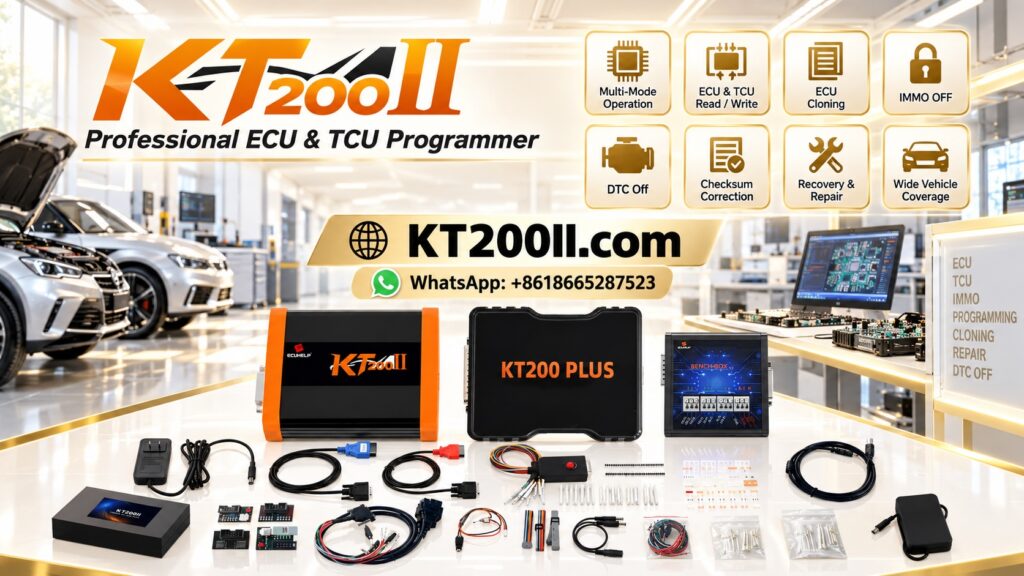
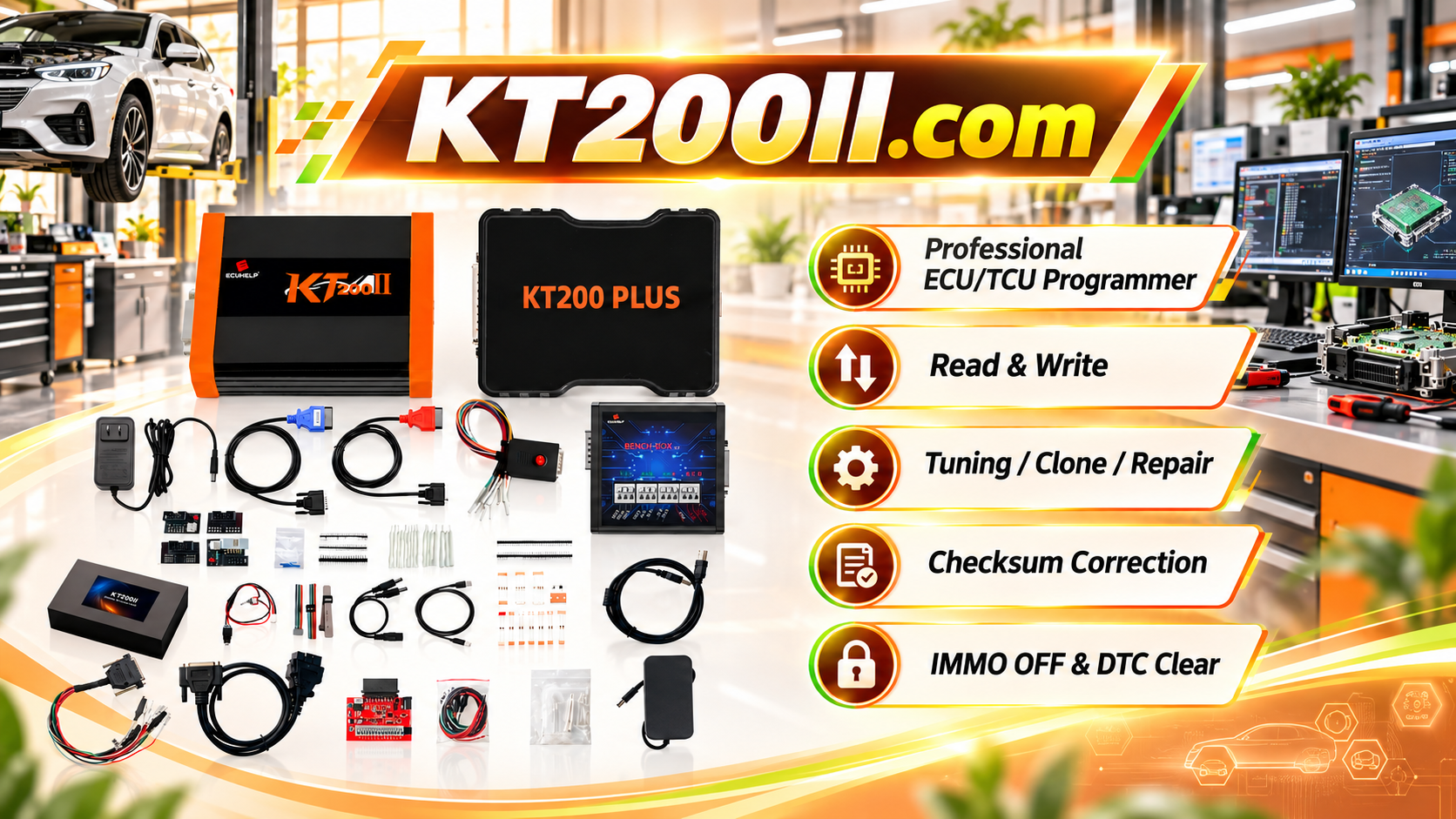
For workshops performing ECU and TCU programming services, KT200II ECU Programmer provides professional ECU programming functions on supported applications.
KT200II supports operations including:
- ECU reading
- ECU writing
- ECU backup
- ECU cloning
- Recovery operations
- TCU programming
Technicians can learn more about supported programming methods through:
Check ECU Compatibility Before Programming
Before performing ECU operations, technicians should confirm vehicle and ECU compatibility.
The official KT200II Support List provides information about supported ECU applications.
Keep ECU Software Updated
New vehicle platforms continue to introduce updated ECU systems.
Keeping programming software updated helps technicians maintain compatibility with newer applications.
The latest software resources are available through:
Conclusion
ECU programmers and diagnostic scanners are both important tools in modern automotive repair, but they serve different purposes.
Diagnostic scanners focus on vehicle diagnosis, while ECU programmers provide deeper access to ECU data and programming operations.
For professional workshops expanding into ECU repair, cloning and electronic services, understanding the difference between these tools is essential for choosing the correct equipment and building an efficient workflow.