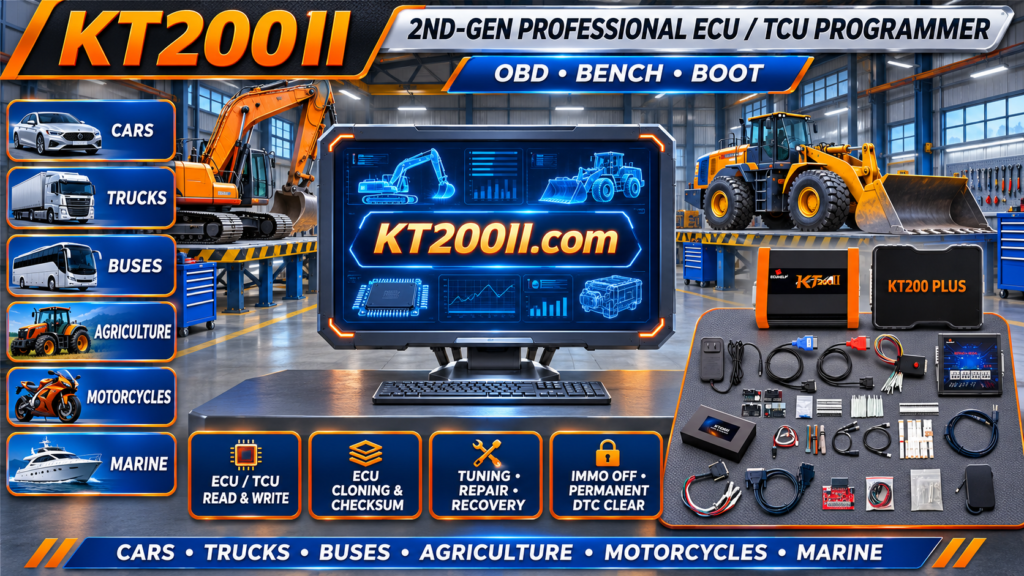

ECU Data Reading and Writing: Understanding Flash Memory, EEPROM and Programming Methods
Modern automotive electronic control units store important software and configuration data that determine how vehicle systems operate. From engine management and fuel injection to transmission control and electronic protection strategies, these functions depend on data stored inside ECU memory.
ECU data reading and writing are fundamental operations in professional automotive electronics. They are used in module diagnostics, software updates, ECU replacement, cloning and supported recovery procedures.
Understanding memory architecture, programming methods and file compatibility is essential for technicians who work with different ECU manufacturers and microcontroller platforms.
1. What Is ECU Data Reading?
ECU data reading is the process of retrieving supported software and memory information from an electronic control unit using compatible programming equipment.
Depending on the ECU architecture and programming protocol, reading operations may provide access to:
- Application software.
- Calibration data.
- Flash memory contents.
- EEPROM or Data Flash information.
- ECU identification information.
- Vehicle-specific configuration data.
- Supported microcontroller memory regions.
Reading ECU data is commonly performed before software modification, module replacement or electronic control unit repair.
2. What Is ECU Data Writing?
ECU data writing is the process of transferring compatible software or data files into supported memory areas of an electronic control unit.
Depending on the application, writing operations may be used for:
- Software updates.
- Restoration of original ECU data.
- Supported calibration changes.
- ECU replacement procedures.
- Compatible module cloning.
- Supported software recovery operations.
Before writing any file, technicians must verify that it matches the target ECU hardware, software version and memory structure.
Using an incompatible file can cause programming failure or prevent the ECU from operating correctly.
3. Understanding ECU Flash Memory
Flash memory is one of the most important storage technologies used in modern automotive ECUs.
It commonly stores the application software and calibration information required for engine or transmission control.
Depending on the ECU, Flash memory may contain:
- Engine management software.
- Fuel injection control strategies.
- Ignition timing calibration.
- Turbocharger boost management.
- Torque limitation parameters.
- Transmission control software.
- Diagnostic functions.
Different ECU architectures use different Flash memory configurations, capacities and access procedures.
For this reason, technicians should identify the exact ECU hardware and supported memory regions before performing reading or writing operations.
4. Understanding EEPROM and Data Flash
EEPROM is a non-volatile memory technology that allows information to be retained even when the ECU power supply is disconnected.
Depending on the control module architecture, EEPROM or equivalent non-volatile storage may contain:
- Vehicle-specific configuration.
- Adaptation information.
- Module identification records.
- Immobilizer-related information where applicable.
- Other manufacturer-specific data.
Some modern ECUs use integrated Data Flash or EEPROM emulation inside the microcontroller instead of a separate EEPROM chip.
It is important to understand that reading Flash memory does not automatically mean that EEPROM or every other memory region has also been backed up.
5. ECU Reading and Writing Through OBD
OBD programming communicates with supported electronic control units through the vehicle's diagnostic connector.
This method allows technicians to perform various supported operations without removing the ECU from the vehicle.
Depending on the ECU protocol, OBD operations may include:
- ECU identification.
- Diagnostic communication.
- Software reading.
- Calibration data reading.
- Supported software writing.
- Selected configuration operations.
OBD is convenient for many applications, but access to every memory region is not guaranteed. Some ECUs require Bench or Boot programming for specific operations.
6. ECU Bench Programming
Bench programming involves removing the ECU from the vehicle and connecting it directly to compatible programming equipment through its external connector.
Depending on the supported protocol, Bench mode may provide access to:
- Direct ECU communication.
- Supported Flash reading.
- Supported memory writing.
- Original data backup.
- Selected ECU replacement procedures.
A typical Bench connection may require:
- Battery positive (B+).
- Ground (GND).
- CAN-H.
- CAN-L.
- Ignition or wake-up signal where required.
Not every ECU uses the same pin configuration. Always follow the exact connection diagram for the target module.
7. ECU Boot Programming
Boot programming is a specialized access method used with supported microcontroller architectures.
It may provide access to memory operations that are unavailable through standard diagnostic communication.
Depending on the ECU design, Boot procedures may involve:
- Microcontroller identification.
- Specialized access connections.
- Supported Flash reading.
- Supported memory writing.
- Selected recovery operations.
Boot programming requirements differ between microcontroller families. Technicians should verify the processor model, hardware revision and programming protocol before attempting access.
8. OBD vs Bench vs Boot Programming
| Feature | OBD | Bench | Boot |
|---|---|---|---|
| Connection | Vehicle diagnostic port | ECU external connector | Specialized processor access |
| ECU removal | Usually unnecessary | Required | Usually required |
| Access method | Diagnostic communication | Direct module communication | Microcontroller-specific procedure |
| Memory access | Protocol dependent | Protocol dependent | Processor and protocol dependent |
| Applications | Supported in-vehicle operations | Direct module operations | Specialized memory operations |
These methods are complementary rather than interchangeable. The correct method depends on the exact ECU and required operation.
9. Why Original ECU Data Backups Are Important
Saving original ECU data before modification is one of the most important professional programming practices.
A verified original backup can help technicians:
- Restore the original software.
- Compare modified and original files.
- Investigate programming errors.
- Support compatible ECU cloning procedures.
- Preserve supported vehicle-specific information.
- Reduce the risk of losing important configuration data.
Backups should be stored securely and labeled with the vehicle information, ECU part number, software identification and memory type.
Technicians should also verify that the saved files are complete and readable before proceeding with modifications.
10. Understanding ECU Checksum Validation
Many automotive ECUs use checksum mechanisms to verify the integrity of software and calibration data.
When a compatible file is modified, its original checksum values may no longer be valid.
Depending on the ECU architecture and programming method, checksum correction or validation may be required before writing.
Incorrect checksum handling can lead to:
- Software integrity errors.
- Programming failures.
- ECU startup problems.
- Diagnostic faults.
- Unexpected module behavior.
Technicians should verify the checksum requirements of the specific ECU rather than assuming every control unit uses the same validation method.
11. Common ECU Reading and Writing Problems
Communication Failure
Possible causes include incorrect wiring, unstable power, damaged connectors or an incompatible programming protocol.
Incomplete Memory Reading
Some protocols provide access to selected memory regions rather than the entire ECU memory. Verify which areas have actually been retrieved.
Incorrect File Selection
Software files from different hardware or software versions may have incompatible memory structures.
Interrupted Writing
Power interruptions or communication failures can affect programming operations. Use a suitable regulated power supply and follow the equipment manufacturer's procedures.
Checksum Errors
Incorrect file integrity handling may prevent successful programming or proper ECU operation.
12. ECU Cloning and Data Transfer
ECU data reading and writing are also important during supported module cloning procedures.
When an original ECU develops an internal fault, technicians may need to transfer compatible data to a replacement control unit.
A typical workflow includes:
- Identify the original ECU hardware and software.
- Check the replacement module compatibility.
- Read all supported original memory regions.
- Save and verify the original backup files.
- Confirm memory structure compatibility.
- Transfer supported data to the replacement module.
- Perform additional coding or synchronization if required.
- Complete diagnostic and functional testing.
Not every ECU supports complete cloning. Some replacement procedures require additional manufacturer-specific configuration or authorized security adaptation.
13. Choosing Professional ECU Programming Equipment
Reliable programming equipment is essential for workshops performing ECU reading, writing, cloning and recovery operations.
When selecting a programming solution, consider:
- ECU manufacturer and model coverage.
- Supported microcontroller families.
- OBD, Bench and Boot programming methods.
- Flash and EEPROM reading capabilities.
- Supported memory writing functions.
- Original data backup options.
- Checksum handling support.
- Connection diagrams and technical documentation.
- Software updates and technical support.
Always verify the exact ECU hardware number, software version and supported operation. General ECU family coverage does not guarantee support for every memory reading or writing function.
For more information about automotive programming equipment and electronic control module solutions, visit AutoECUMaster.
14. Best Practices for Professional ECU Programming
A structured workflow helps improve programming reliability and reduce unnecessary risks.
- Identify the exact vehicle and ECU hardware number.
- Record the original software identification.
- Confirm the supported programming protocol.
- Use the correct connection diagram.
- Prepare a suitable regulated power supply.
- Read and save all required original memory areas.
- Verify backup files before modification.
- Check software and hardware compatibility.
- Confirm checksum requirements.
- Perform diagnostic and functional checks after writing.
15. Conclusion
ECU data reading and writing are fundamental operations in modern automotive electronics. Understanding Flash memory, EEPROM, microcontroller architecture and different programming methods helps technicians perform supported software operations more effectively.
Whether working with OBD, Bench or Boot programming, accurate ECU identification, stable power supply and verified original backups are essential for reliable results.
By using compatible programming equipment and following a systematic workflow, automotive professionals can improve their ability to diagnose, repair and maintain modern electronic control modules.
For more information about automotive ECU programming technology and professional programming equipment, visit AutoECUMaster.