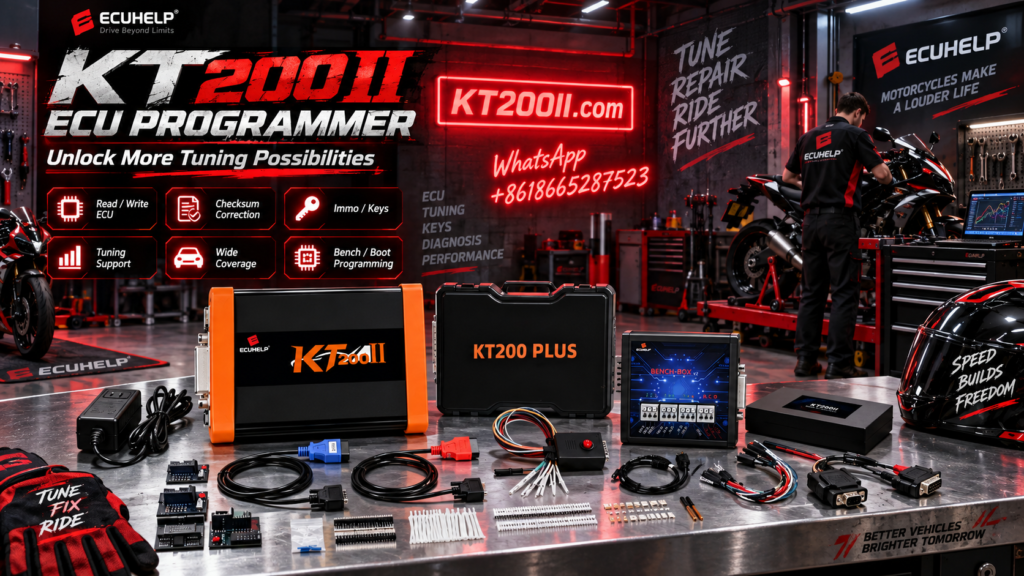

How to Program Bosch EDC17CP54 ECU with KT200II
Programming a Bosch EDC17CP54 requires exact controller identification, stable power and a file matched to the selected protocol and memory operation. The EDC17CP54 family name alone cannot confirm the correct connection method or file compatibility.
This guide explains a professional KT200II workflow for supported EDC17CP54 applications, including OBD, Bench and Boot mode selection, original backup validation, writing and post-programming diagnostics.
About Bosch EDC17CP54
EDC17CP54 belongs to the Bosch EDC17 diesel engine-management family. Depending on the application, the ECU may manage fuel injection, boost control, torque coordination, emissions-related systems and communication with other vehicle modules.
Controllers with the same EDC17CP54 family name can contain different:
- Bosch and vehicle-manufacturer part numbers
- Hardware revisions
- Software versions
- Calibration datasets
- Vehicle and engine applications
- Security configurations
- Memory layouts
- Supported programming operations
KT200II.COM is the official KT200II product website. It provides the central KT200II product information, software resources, operation-mode explanations, supported ECU and TCU database and technical programming guides.
Document the ECU Before Programming
Vehicle Information
Record the manufacturer, model, year, engine, transmission and relevant vehicle identification.
Physical ECU Label
Photograph all Bosch numbers, manufacturer references, barcodes and revision markings.
Electronic ECU ID
Save the hardware, software, calibration and other identification reported by the confirmed protocol.
Pre-Write Condition
Document warning lights, starting behavior, battery condition, existing faults and known symptoms.
Perform a complete vehicle diagnostic scan before programming. Save the report before clearing any faults so the original vehicle condition remains documented.
Confirm Current KT200II Support
Search the exact controller or vehicle application in the official KT200II Support List.
Confirm every available protocol detail:
- Exact ECU and vehicle application
- Supported KT200II protocol
- Required OBD, Bench or Boot mode
- Electronic identification availability
- Virtual Read or physical Read availability
- Supported Flash, EEPROM, Micro or backup operations
- Available Write and recovery functions
- Protocol-specific connection and power instructions
OBD, Bench and Boot Mode Comparison
| Mode | Typical Workshop Use | Main Precaution |
|---|---|---|
| OBD | Supported identification, Virtual Read, physical Read or Write with the ECU installed | Maintain stable vehicle voltage and follow every ignition instruction. |
| Bench | Direct communication through the external ECU connector after removal | Verify every power, ground and communication terminal before applying power. |
| Boot | Supported deeper memory access, complete backup or recovery operations | Open the housing carefully and follow the exact controller-specific diagram. |
The official KT200II Operation Modes page explains OBD, Bench, Boot, JTAG and BDM access.
Use the least invasive supported method that provides the functions required for the job. Do not open an ECU unnecessarily when a confirmed OBD or Bench procedure already supports the intended operation.
Prepare Stable Power and Communication
- Use an appropriate regulated vehicle-support or Bench power supply.
- Confirm voltage and polarity before connecting the ECU.
- Inspect cables, adapters and connector terminals.
- Secure the ECU and all connections against movement.
- Connect KT200II to a reliable laptop USB port.
- Prevent laptop sleep, automatic restart and shutdown.
- Close unnecessary applications before writing.
- Monitor voltage throughout reading, writing and verification.
- Keep unnecessary vehicle consumers switched off.
EDC17CP54 OBD Workflow
Save the Diagnostic Report
Confirm normal ECU communication and record all current and stored faults.
Stabilize Vehicle Voltage
Connect the regulated support supply before beginning identification or programming.
Select the Exact Protocol
Match the controller label, vehicle application and current KT200II support entry.
Read ECU Identification
Save the complete ID and compare it with the physical ECU label.
Perform the Supported Read
Identify whether the result is Virtual Read, physical data or another protocol-specific file.
Validate the Write File
Check the source, hardware, software, size, memory operation and checksum requirements.
Write and Finalize
Keep voltage and communication stable until KT200II confirms complete success.
EDC17CP54 Bench Workflow
Bench mode connects directly to the removed ECU through its external connector. When supported by the exact protocol, it provides direct communication without opening the housing.
- Follow the correct vehicle procedure before disconnecting the battery.
- Remove the ECU without damaging its connectors or housing.
- Confirm the complete label after removal.
- Select the exact EDC17CP54 Bench protocol.
- Open the corresponding KT200II connection diagram.
- Connect all required power, ground and communication terminals.
- Inspect the setup before applying power.
- Read and save ECU identification before accessing memory.
- Create every supported original backup required for the job.
- Keep the ECU and cables stationary until finalization is complete.
EDC17CP54 Boot Mode Preparation
Boot mode may provide supported memory access or recovery functions unavailable through standard communication. Because the ECU normally needs to be opened, physical preparation is especially important.
- Clean the ECU exterior before opening it.
- Use suitable tools and controlled heat where required.
- Avoid inserting tools into the circuit-board area.
- Protect the board against bending and static discharge.
- Confirm the exact board orientation shown by the protocol.
- Use only the designated Boot and communication points.
- Do not probe unidentified components.
- Secure probes and adapters against movement.
- Keep conductive debris away from the board.
- Reseal the housing after successful testing.
Create and Protect the Original Backup
Save all original data made available by the confirmed protocol before writing. One saved file does not necessarily contain every memory area required for recovery or replacement work.
| Data Type | Possible Content | Storage Rule |
|---|---|---|
| Virtual Read | Matching software obtained through a supported identification workflow | Label it as Virtual Read and preserve the ECU ID used to obtain it. |
| Flash | Program, calibration or protocol-defined Flash data | Record the exact mode, operation, byte count and completion result. |
| EEPROM | Configuration or controller-specific data where supported | Store it separately and associate it with the physical ECU. |
| Micro or MCU | Processor-related data exposed by the selected protocol | Record the controller, protocol and memory function. |
| Full Backup | A protocol-defined collection of accessible memories | Confirm which memory regions are included. |
Keep the master original unchanged. Store modified and final Write files separately from the original backup.
Validate the Read Before Editing
- Confirm that KT200II reported successful completion.
- Record the exact file size in bytes.
- Match the file with the selected memory operation.
- Repeat the Read where appropriate.
- Compare repeated results for size and data consistency.
- Confirm that no voltage or communication error occurred.
- Separate Virtual Read files from physical reads.
- Do not remove unknown headers or manually resize the file.
- Associate every file with the original ECU identification.
Verify the Candidate File
Controller References
Compare the complete Bosch and vehicle-manufacturer part numbers.
Hardware
Verify the hardware number and relevant controller revision.
Software
Compare software and calibration information with the connected ECU ID.
Memory Operation
Use Flash, EEPROM, Micro, Virtual Read or backup data only with its matching function.
Checksum and Compatibility
| Validation Check | What It Helps Confirm | What It Cannot Prove |
|---|---|---|
| ECU Identification | Hardware and software reported by the connected ECU | Compatibility of an external file by itself |
| File Size | Expected length or obvious truncation | Correct software or vehicle application |
| Checksum | Internal consistency of supported data regions | Correct ECU hardware or memory layout |
| Filename | The workshop description of a file | Authenticity, origin or compatibility |
Determine whether checksum correction is performed by the editing software, KT200II protocol or another verified stage. Keep the unmodified original and document how the final Write file was prepared.
Professional EDC17CP54 Write Procedure
Read the ECU ID Again
Confirm that communication and identification still match the documented controller.
Select the Correct Write Function
Match the candidate file with the supported memory operation.
Inspect the Final File
Verify the source, size, hardware, software, modification and checksum status.
Check Power and Connections
Inspect the complete setup and confirm voltage stability.
Start the Write
Do not move cables or operate the ignition unless KT200II requests it.
Wait for Finalization
Remain connected until verification and the complete success message are finished.
Follow the Exact Power Cycle
Complete all requested ignition or Bench power changes and waiting periods.
Post-Write Verification
- Read ECU identification again.
- Confirm the intended software information.
- Perform a complete vehicle diagnostic scan.
- Save the post-write report before clearing faults.
- Compare new faults with the pre-write report.
- Check communication and voltage-related faults.
- Review relevant engine and network live data.
- Confirm normal cranking and starting.
- Observe warning lamps and idle quality.
- Complete required authorized coding or adaptation.
- Perform a controlled functional test.
- Run and save the final diagnostic scan.
If Communication Fails After Write
Do not perform repeated random writes. Preserve and record:
- Complete KT200II error message
- Exact protocol selected
- OBD, Bench or Boot mode used
- Original ECU identification
- Original backup filenames
- Exact file written
- Write completion status
- Finalization and power-cycle steps
- Vehicle or Bench voltage condition
- Current ECU communication result
Confirm the exact controller again in the official support database and determine whether the original protocol provides an appropriate supported recovery operation.
Common EDC17CP54 Programming Mistakes
| Mistake | Possible Result | Prevention |
|---|---|---|
| Selecting by ECU family only | Incorrect protocol or connection mode | Match the label, vehicle and electronic ECU ID. |
| Programming with unstable voltage | Interrupted Write or communication loss | Use and monitor an appropriate regulated supply. |
| Using an unrelated Bench diagram | Incorrect connections or ECU damage | Follow the exact selected-protocol diagram. |
| Confusing Virtual and physical Read | Incorrect assumptions about backup contents | Document the source and purpose of every file. |
| Writing an unverified file | No-start, faults or abnormal operation | Verify hardware, software, memory and checksum. |
| Disconnecting at 100 percent | Interrupted verification or finalization | Wait for the complete success message. |
KT200II EDC17CP54 Checklist
- Vehicle and engine information recorded
- Complete ECU label photographed
- Pre-write diagnostic report saved
- Exact KT200II protocol confirmed
- Current KT200II software used
- OBD, Bench or Boot mode verified
- Connection diagram checked
- Stable power supply connected
- Original ECU identification saved
- Supported original data backed up
- Exact file sizes recorded
- Virtual and physical reads separated
- Candidate file compatibility verified
- Checksum workflow confirmed
- Correct Write function selected
- Complete success message received
- Requested power cycle completed
- Post-write ECU identification saved
- Complete vehicle scan performed
- Functional test completed
- Original and final files archived
Official KT200II Resources
- KT200II.COM official product website
- KT200II product introduction and versions
- KT200II OBD, Bench, Boot, JTAG and BDM modes
- KT200II Software Download
- KT200II supported ECU and TCU database
- KT200II technical programming guides
Final Recommendation
Professional Bosch EDC17CP54 programming depends on exact controller identification, current protocol confirmation, stable power and a protected original backup. Use only the connection mode and memory operation supported for the controller in front of you.
Before writing, verify the hardware, software, file source, memory function and checksum workflow. After programming, follow the complete finalization sequence, read ECU identification again and perform diagnostic and functional checks. If communication or vehicle operation is abnormal, protect the original files and diagnose the cause before another Write.
Confirm EDC17CP54 Support Before Programming
Search the official KT200II database for the exact ECU application, supported functions and required operation mode.
Search KT200II Support Compare Operation Modes